


The question whether mold material is safe to use, regularly comes up on multiple forums, and there is no more a yes or no answer to the question, than there is about eating wild mushrooms. All molds were not created equal!
Like mushrooms, molds belong to families, and while some are salubrious and even used by us in manufacturing processes, others can be deadly.
All of us have smoked moldy material, whether we knew it or not, because it is all around us, but unless you have a compromised immune system or are allergic to the spores, you don't notice it.
In quantities large enough to create an allergic reaction, or with compromised immune systems however, the results range from a runny nose, to death.
The mold spores are the principle source of allergic reactions, but allergic reactions aside, some of the molds produce aflatoxins that attack our central nervous system and livers. Mold material can easily be removed by filtration, but filtration doesn't remove aflatoxins.
When considering what to do with moldy material, the pregnant question is what kind of mold? What caused the mold is a clue, but the only reliable way to tell, is with a microscope, and I recommend that you do a microscopic examination to determine exactly what you are dealing with.
Locally, due to our short growing season, Botrytis bud rot is the bane of outdoor growers, and because of our high humidity, Powdery Mildew is everywhere.
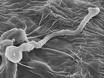
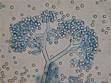
Botrytis Mold
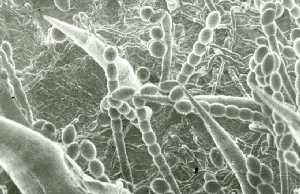
Powdery Mildew
The good news is that while the spores of both are capable of producing a Type I allergic reaction to those sensitive to them, neither produce know aflatoxins, so simply removing all the spores and mold material, makes it useable by removing allergens, as well as the ghastly moldy taste and smell.
Botrytis is actually the mold that produces Noble Rot in grapes, which is highly prized by wine makers for producing sweet wines. I know of no prized use of ubiquitous powdery mildew and it is known by many other names, some of them not repeatable in polite company.
Of serious concern, and not to be taken lightly, are the Aspergillus and Penicillum molds, which are hard to distinguish from one another with simple microscopic examination, so are generally classified as Pen/Asp types.
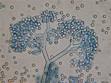
They are easy to spot, as they were named Aspergillus because their shape, consisting of a shaft with a head like the religious water flinger the priests use, called an Aspergillum. 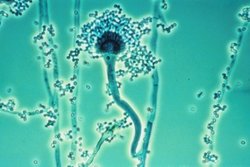
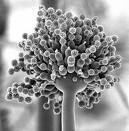 http://en.wikipedia.org/wiki/Aspergillus_fumigatus
Aspergillus is primarily a composting mold living off dead plant material, while Botrytis and Powdery Mildew target living material.
As previously noted, it has spores everywhere, but poorly cured material is the primary reason for an infestation. It likes to grow in dark damp places.
Aspergillus is the more serious actor when it comes to serious health effects, both from allergic reactions to its spores, invasive colonization, and from its aflatoxins, but Penicillium sp. is known to cause keratitis, external ear, respiratory and urinary tract infections, so it isn't soft and cuddly.
The allergenic effects seen by Aspergillus spores include: Type I allergies; Type III hypersensitivity pneumonitis and others.
Some Aspergillus species are known to produce aflatoxins. A. fumigatus causes allergic bronchopulmonary aspergillosis and allergic fungal sinusitis.
Members of this genus cause a disease called Aspergillosis, which is an invasive infection, colonization, toxicoses or allergy.
Many species grow at body temperature and they are opportunistic pathogens, causing infection in individuals with compromised immune systems.
Many toxins are generated by this genus, however, the full range of effects of these toxins are not well researched at this time. They do fluoresce under ultraviolet light however, so their presence may be detected by examination under a black light inspection lamp, such is used in Magnetic Particle and FPI Non-destructive Inspection techniques.
The aflatoxins will fluoresce green under the blacklight and any residual solvent will fluoresce blue. 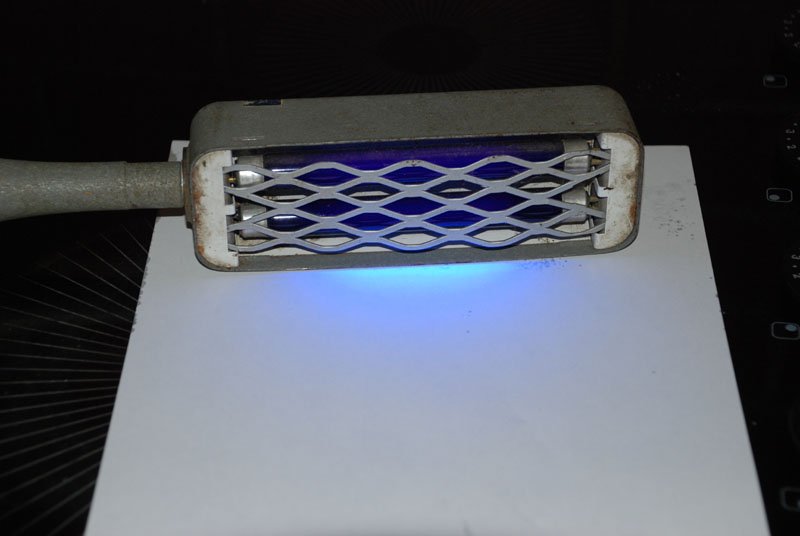
While not a mold, a bacteria anaerobic conditions created by poor curing practices promotes the growth of, and which has been found in poorly cured cannabis, is the Clostridiums.
The Clostridiums includes C botulinum causing botulism in food, and from which Botox is derived, as well as C Perfringens, which causes food poisoning and gas gangrene, as well as C Tetani, the pathogen causing tetanus.
http://en.wikipedia.org/wiki/Clostridium
Soooo, now that you know what to look for, if after examining your moldy material under a microscope, you still want to recover it, here is how we remove Botrytis and Powdery Mildew filaments and spores, as well as any of the Clostridium bacteria that may be present.
Our next step is to extract the essential oil from the plant material, using either an alkane or an alcohol.
If we use hexane or an alcohol, we do the filtration before evaporating off the solvent, or if we extract with butane, we redissolve the BHO in at least ten times its volume in ethanol for filtration.
Rough filtration:
We first filter through a coffee filter to remove the gross material and then through a Whatman #1 lab filter, using a vacuum assist, to save time. 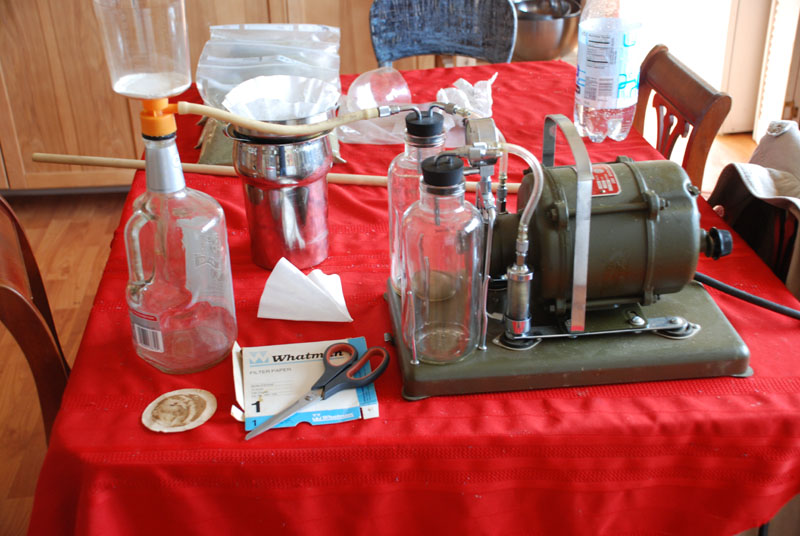
Micro filtration:
Once it has been rough filtered, we then follow up by polishing it at 0.2 microns, using a 0.2 micron syringe filter. It has a Luhr fitting, and screws on the syringe just like a needle. 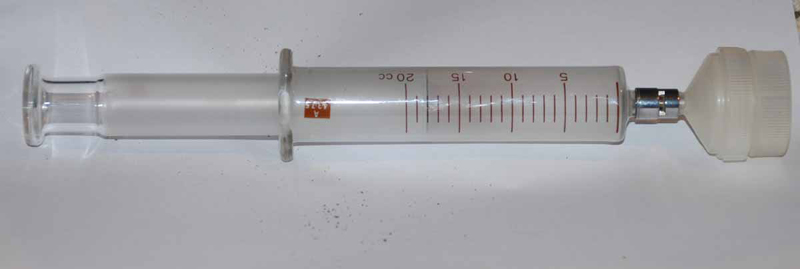
In industry, I used 0.2 micron cross flow micro filtration units to scrub radio active effluent streams at up to 100 gpm, but for small needs like ours, the syringe filter suffices.
They are readily available relatively cheap on E-Bay, or at reasonable prices at American Scientific, as are the syringes.
Once we have filtered at 0.2 microns, we remove the solvent by one of several methods, and the oil will have no hint of mold flavor or taste.
Since it is the spores that cause the Type I allergic reactions, that hazard is eliminated as well.
Any Clostridiums are removed, so subsequent storage in anaerobic conditions can't provide favorable conditions.
To repeat, filtration doesn't remove aflatoxins, so we don't recommend this process for mold strains that produce them.
The attached read is a good overview on some of the other things you may find in cannabis:
Thanks for posting this. We ran a test on bho extract. Ran a 5gal bucket full of the nastiest Mold we had. We had it tested and to our amaze it passed the mold tests with flying colors. So I told him what we did and he ran it again for me. Same results. So from your arrival I would have to assume that the packing of the material and the micron screens I run did the trick for filtering. I would like to here you point of view on this. Thanks again for the article.
I've been reading about Malawi Cob Curing. Some people claim it's the best way to cure cannabis. Yes, I know... maybe it is and maybe it isn't. :-) The slightly dried cannabis is tightly wrapped in corn husks and tied tightly with twine. Then the wrapped weed is placed in a warm somewhat humid place to cure for a long time so natural enzymes break down the plant material. Sometimes it's buried in the warm ground (dirt) and sometimes it's vacuum sealed and place in a very warm place. From what I understand, in basic terms, it's similar to what many tobacco growers to to cure and age tobacco leaves. QUESTIONS: Since the process is largely or completely anaerobic, is there a concern about growth of clostridium bacteria? Would heat prevent it? What temperature?
Botulism and Aspergillus composting molds would certainly be my concern. Both produce toxins separate from their bodies, that can't be filtered even at 0.2 microns. The various studies that I've seen on clostridium bacterial vary some, but it looks like 57C/134.6F is at the upper limits of its growth range, which conveniently falls under the 140F food handling rules. Aspergillus flavus can exist between 12 °C (54 °F) and 48 °C (118 °F), with an optimum growth temperature of around 37 °C (98.6 °F). Seeking the perfect smoke is alluring, though I no longer smoke because of the free radicals and carcinogenic byproducts of pyrolysis. Instead I vaporize, and suspect losing most of the monoterpenes doesn't add to the aroma and flavor for that purpose. I also note the horror stories surrounding Aspergillus setting up colonies on folks lungs, especially those from smoking buried cannabis, so advise proceeding on the side of caution. GW
Thank you for the informative and helpful reply. If I decide to try this type of curing then I'll assure the temperature stays well above 150 and below 170 Fahrenheit. If the other forum rules allow it, I'll link this page to the thread I got the idea from. If they don't allow linking then I'll cut/paste your reply in that thread... if that's okay with you. Safety first!! Thanks Again, Mike
Works for us. GW
Thank you for your first reply and all the info here! Very useful. However I have another question.The 0.2 syringe filters I find on amazon says there are not intended for medical use, Industrial use only. Are these no good If technically Im making medicine. Will these filters leave any residual unwanted chemicals in my oil?
We use a sterile scientific grade in a standard brand like Whatman. They are ostensibly the same, with the medical grades requiring more certifications. Neither leave chemicals in your ethanol tincture. GW
Need some help on this subject. Today I purchased a half pound to make rick simpson oil for my roomate who was just diagnosed with liver cancer. I did not realize untill I was carefully inspecting the buds later at home that one bud in the half pound had visible mould. It appears to be botrytis but I cannot be 100 certain. Upon further inspection many smaller buds were a shade of brown from what appears to be bud rot. Im very displeased as I previosly explained my position to the supplier informing him there should be absolutley no mould, mildew or pesticides. The cost was a hefty 1200 and I do not think I will be getting a refund. Its alot of money for myself and my friend does not have any cash for another half pound nor do I. So my question is this, if the mold is botrytis would you advise making rick simpson oil using this method of filtration for someone who currently has cancer? We cannot afford more cannabis, is it worth it to still make the oil or should we throw it away? I really hope we dont have to throw $1200 away but Im fearing the worst.
Botrytis produces no known aflatoxins, but some folks have Type 1 allergic reaction to the spores and filaments. If you filter those out at 0.2 ostensibly those are gone, but given the patients current state, I would have a filtered sample tested for mold and aflatoxins. GW
All is going as it should.
I need to know if moldy bud can be salcaged as a tincture or salve for aches and pains?
Define mold? They aren't all created equal. Molds that grow on living tissue, like Powdery Mildew and Botrytis, produce no known aflatoxins, so if you filter the concentrate and alcohol solution through a 0.2 micron syringe filter, it should be good for that application. While they aren't toxic, they smell and taste like mold, and some folks can have a Type 1 allergic reaction to just the spores and filaments of Botrytis. Composting molds growing on dead tissue on the other hand, may produce aflatoxins, and they won't be removed by the filtration. Aflatoxins attack the central nervous system. They can also be carried into your body with the transdermal cannabinoids, so using as a topical isn't a good idea either. Aspergillus is one of the most common composting molds, and if you look at the mold or the aflatoxins that it produces under a NDT inspection black light, it will phosphoresce green, which may give you some idea whether it's present or the degree of the contamination. GW
Aflatoxins can be easily removed using activated charcoal.
The cost of being mistaken is high! Do you have any clinical study information supporting that, which you can share with us? GW
Does Co2 extraction process like Bhang uses kill aflatoxins ?
Aflatoxins are already dead, but still toxic. They are excreted waste products from the mold. GW
Ok, so here is a question. If you have a water Filtration device( You know what I mean.). And get a .2 Micron filter Water or otherwise, Submerge it in the water to defuse the Smoke or Vapor. Would that in affect filter out and of the Spores.. I know there are large gaps in there like the ethanol vapor and so on.
Is this done when the material is wet or dry? For bud rot at time of harvest. I was going to dry it separately and then run it. Thanks!
Great information. Thank you. "or if we extract with butane, we redissolve the BHO in at least ten times its volume in ethanol for filtration." Can you expand on this a bit? Is there an issue with running butane through a .22 PTFE filter? My understanding of PTFE is that it is generally non-reactive. But does that hold true with butane? I currently use .22 PTFE at the bottom of the column to blast through. Works great, crystal clear results w/o winterizing. But is it depositing poisons in the product? Any worse than using a metal spatula in a Teflon pan?
The problem is with undiluted bho not passing through the filter. You are diluting so it should work. Teflon is compatible with butane.
Im no chemist so cant explain terminology but butane evaporates too quickly applying much pressure to filter or syringe. I tried to syringe up butane before and it just squirts uncontrollably. Ethanol has a slow evaporation rate so is more controlled and also does not dissolve the fats so you can defat using ethanol but not butane as it dissolves the fats too. Hope this helps
Wow, I’m really happy to have found this site, it’s very informative. Thank you for sharing your discovery of how to remove the nasty mold spores from our beloved bud I was wondering if a Sawyer MINI Water Filter can be used instead of a 0.2 micron syringe filter. Here’s the link http://sawyereurope.com/water-filtration/sawyer-mini-water-filter. It is a 0.1 micron filter made out of Hollow Fiber. Could you please be so kind and let me know what you think of it, or should I rather use the 0.2 micron syringe filter? My concern with the 0.2 micron syringe filters it that it would take me ages to filter 50 oz. of ethanol solution using syringe filters and I would need at least 20 of the syringe filter. I would be very happy to get your expert opinion and advice.
Dunno bro! They aren't giving any clues as to what type of plastic the case is, or what the fibers are made of. I principle it sounds good, but the devil is in the compatibility details.
Hey, did you ever use that water filter. I have the same issue as you and Im looking for a solution.
Hi, I hope you can give me some advice. Question1) Does your filtering method with the 0.2 micron syringe filter decrease the potency of the oil by filtering out the dissolved cannabinoids and terpenes within the solution? I have been drying cannabis in an environment that was too damp and cold. The result is that the buds look perfectly normal but some have a tiny bit of spider web-like threads on them, which is an onset of mould. These spider web-like threads can barely be noticed with the bear eye and I used a jeweller’s loupe to identify them. However when inspecting the buds under 60X magnified jeweller’s loupe, I saw just a few white spores on long shafts on some buds and this sounds like Aspergillum mould, but I'm not even sure that it’s possible to distinguish Aspergillum mould from Botrytis mould under a 60x jewel’s loop. Question2) If the buds look perfectly normal and only with the help of a jewler's loop I was able to spot a tiny bit of spider web-like onset of mould and just a tiny bit of the spores on long shafts then my weed can't possibly have much aflatoxins, right? Any other person would probably not even have noticed the onset of mould on my buds. If I make rick simpson oil with190 proof grain alcohol and then heat it to 250 F for 25 minutes to decarb it, then it would eliminate all the mould and allergens from the oil, but the tiny bit of the aflatoxins will still be present even if I use your filtering method with a 0.2 micron syringe filter. Question 3) If I only use the heat and 190 proof grain alcohol, without the 0.2 micron filtration, then I will destroy the proteins and therefore kill all the spores but could it still cause an allergic reaction for sensitive people? Question 4) Will the 0.2 filter really remove all the mould residue and therefore prevent any allergic reactions even in people allergic and sensitive to mould? P.S. I know that the filter does not remove any aflatoxins that have already been developed by the mould. Sorry, really did not want to make that long of a post, but can't find any answer to my questions anywhere else and hope you can enlighten me.
Your ranking: None.
You're too kind! GW
Holy frack. Another person's poor pineal gland locked up and they zombied RIGHT out...!
GW, Been looking hard to find size info on PM and think I found it on page 92 of this study: http://ufdc.ufl.edu/UFE0044229/00001. There are hundreds of Conidia lengths of powdery mildew. Not one dimension in any of the samples was below 10um, the smallest seemingly averaging at 11-12um. I have a filter stack at the base of my column that steps from 10 microns, through 8 micron pyrex wool, finally through a 5 micron Filter. Based on the dimensions listed in the study, should this be adequate to remove PM?
Is there any chance you can link direct resources for the Filter and a larger syringe?,,,I'm just not looking to buy the wrong equipment...
Microwave kills afloxatins
Lots of peace to the skunk pharm! Here is a nice, very peer-reviewed study from the wine-making industry: http://onlinelibrary.wiley.com/doi/10.1111/j.1365-2672.2004.02280.x/pdf The conclusion of the study was: "Complete inhibition of all fungal spores in our work occurred after exposure to 30% (v/v) ethanol at 40C". They were using a 30-second wash (which was the industry standard for existing machines, i.e. - nobody was going to like that study if " additional capital investment" was part of the conclusion. ;-) These guys were cool as crap - they actually *cultured* at the end to see if anything even *might* still be alive (hence they discuss "everything dead as crap" with the science-ey term "inhibitory effect". Ha! I *wish* I was always that serious. Peace and good things to all! -OldOyler
Hello there, First of all, thank you very much for all the resources you share on this website. Do you know if these nasty spores and "aflatoxins" will be extracted along with THC and terpens using butane, ethanol, olive oil, VG, PG, PEG or other solvents used for cannabis? Or is there a solvent that could be used to extract potential aflatoxins and spores without extracting any goodies from moldy material? Cheers
i recently had a kidney transplant and have a compromised immune system. doctors say this aspergillos could be deadly to me. i dont like eating cannabis and am looking for ways to kill or remove this mold/spore from my smoking materal. seems like the rick simpson method may be a good way, but i need to be sure. help!
The Aspergillus filaments and spores can be filtered out at 0.2 microns, along with any bacteria present, but any aflatoxins they produce will not be removed by filtration. The best way to avoid Aspergillus, is unfortunately to not grow it in the first place.
not growing is not an option. we take precautions, large carbon filter,hepa filter in the room while trimming, and a mask for myself when i feel it necessary. im asking more about smoking than growing. would soaking some herb that has been visually inspected in grain alcohol, than straining the matter out and using a double boiler to evaporate the alcohol out eliminate the possibility of this spore being in my final product? my doctors are not worried about the smoke, but are very worried about this spore "aspergillus"
I'm researching and looking for commercial size experienced operator, planner of a central processing oil center. Need help with equipment types sizes and such for all types of high quality concentrates.
Hello and Happy New Year to you all! I am going to be doing this with kief from a 145u dry sieve of which the material had mildew. First I will thermos extract as you instruct, then to winterize with the ethanol. So I just wanted to make sure, is it ok I am planning to winterize in combo with the mildew filtration? Seems like I can just go from freezer to the first step of this polishing combining with end of winterizing, just wanted to double check before I go through this extra work. Thanks so much for all you hard work .. keep it up yal.. Bless
[…] Check this out. It may help. http://skunkpharmresearch.com/salvag...dy-material-2/ Reply With […]
I have been wanting to try this technique. I finally collected all the supplies. I mixed my freshly extracted oil with alcohol for winterizing. I removed the mix from the freezer and ran it through a #1 whatman filter. Then I used heat to remove the alcohol. When that was finished I tried using the syringe filter. I have a 60ml syringe with a 25mm dia. 0.22 micron hydrophobic PTFE filter. The oil is nearly impossible to draw through the filter. I tried filling the syringe and pushing the oil through but that didn't work either. I diluted the oil with more everclear but that didn't work either. I have seen the same PTFE filter material cut in circles to fit a Büchner funnel, would this be a better way to process larger amounts of oil? Maybe I'm using the wrong filter media? Maybe I didn't dilute it down enough? Any advice would be much appreciated, Thank you.
Try the cellulose acetate filters.
""I removed the mix from the freezer and ran it through a #1 whatman filter. Then I used heat to remove the alcohol. When that was finished I tried using the syringe filter."" I think the order of operations got mixed up. Remember, the solvent is your friend.
"Once we have filtered at 0.2 microns, we remove the solvent by one of several methods, and the oil will have no hint of mold flavor or taste."
I also tried the 0 .22 syringe filter and found it far too slow to filter the amount of material I need to go through it. You mentioned using a cellulose acetate filter. Would you recommend the 142mm ones that some companies sell using vacuum assist? That would be a perfect size for my Buchner funnel. I thought I would ask first since those filters are rather expensive at $150.00 for 25. Thanks so much!
Once I'm set up ill be here in sf Cali ......
I am planning on setting up vacuum filtration, and was hoping you could give me some advice. Is there a specific model of bottle top vacuum filter you would recommend for use with a Robinair 15500? Would 5 CFM be to high for this model? : http://www.amazon.com/Argos-Membrane-Aspirator-Filtration-micrometer/dp/B007JNO2LO/ref=sr_1_1?ie=UTF8&qid=1359173174&sr=8-1&keywords=bottle-top+vacuum+filtration Also not sure if the .22 micron membrane could be removed and replaced with a grade 1 Whatman. I don't need a collection vessel any bigger than 250mL. Any and all help would be gratefully appreciated! Thank you for all the information. What an amazing resource!
The filter unit looks OK and should work with your 5 cfm Robinair, but without examining it, it is unclear how easy it is to change membranes. Consider a simple Bushner funnel and vacuum flask, and just drop in filters. I would recommend the largest filter you can find, to get the fastest drain before clogging. GW
Are you suggesting salvaging moldy material? My nose always runs when I medicate, does that mean there is mold in all the medication I have sampled? Yikes!!!
I’m showing a way to salvage material with powdery mildew, or botrytis, not composting mold like aspergillus. Not sure why you might have a runny nose when you medicate, other than it is seemingly irritating your nasal or sinus cavities. How are you medicating?
It's only when I smoke it...... Maybe it's just me, thank you for the update!
You might switch to vaporization. It is less irritating.
Thanks Skunk Pharm for sharing this information with us. If we can not do this ourselves can we get help from you? And if so How do we contact you?
Good question bro! We are not a service organization, but have trained folks who do plan to provide those services. We will post those businesses that we have trained and certified, as they open for business. Curently, Specialized Formulations is the closest to opening their doors, and will offer extractions, formulations, and alchemy of patients own material. They are fully trained, but still working on their facilities. Oregon Medical Growers in Gaston is also fully trained and not far behind getting set up, so they may be a second possibility.