


I'm sure those of ya'll whom have purchased high purity Ethanol have noticed that it isn't cheap with all the taxes heaped upon it, so here is how we recover and continue to use the alcohol in our process that we've already paid over $20 a liter for.
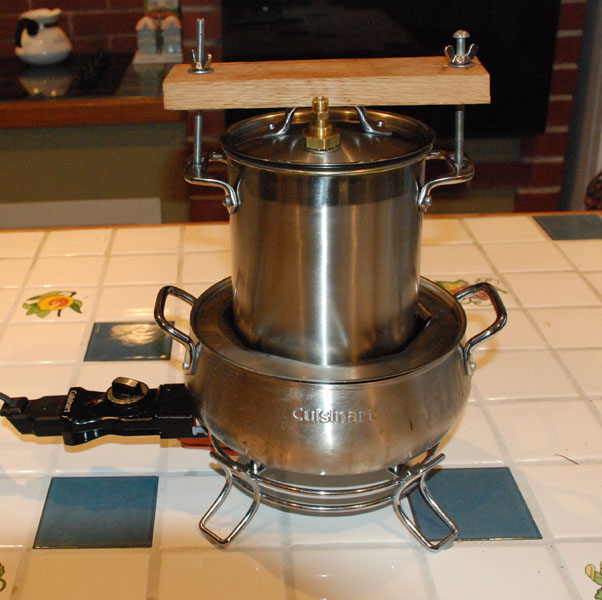
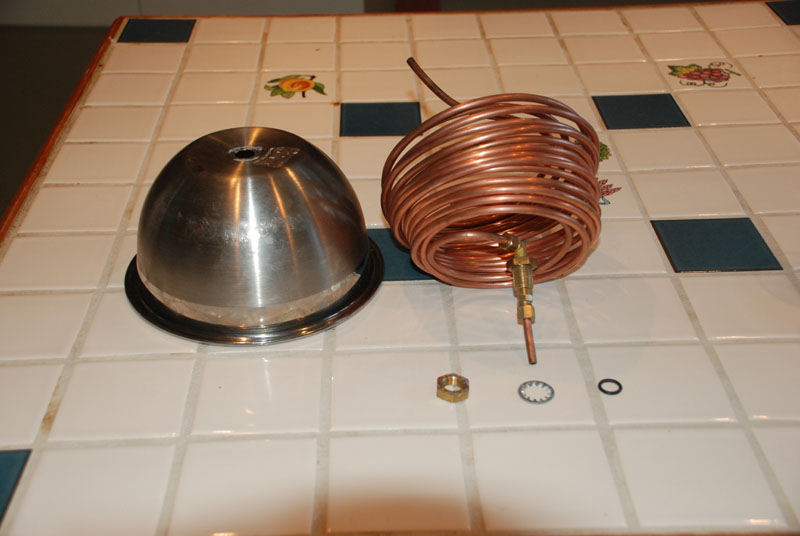
As we are working with small volumes, what we use, is a simple pot still made out of an All Clad stainless asparagus steamer pot, a Quisinart electric fondue pot, and a stainless mixing bowl, in which I have inserted 12 1/2 feet of 3/16" ID copper tubing.
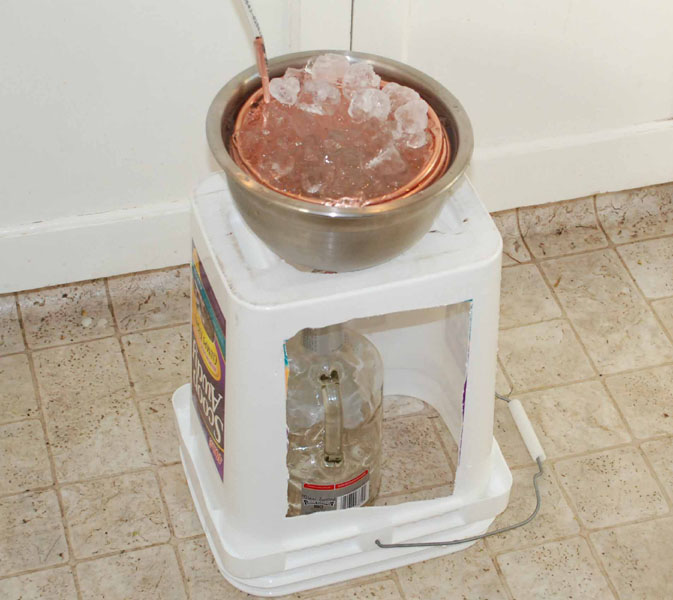
The salad bowl condenser rests on a modified cat liter bucket, over an empty 1.75 liter Clear Springs bottle for final collection.
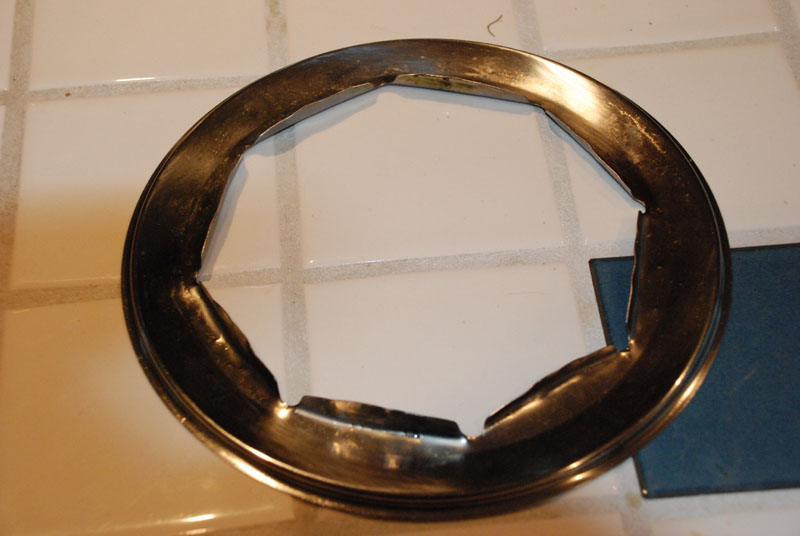
The only modification to the Quisinart was to bend the ears of the top fork ring down, to permit the insertion of the asparagus pot, and placed canning jar lid rings in the bottom, to suspend the asparagus pot above the bottom, so as to eliminate hot spots.
The Quisinart is a good choice, because of its sensitive controls for alchemy, but for distillation application, its controls are wide open, until we throttle it back to 250ºF for finishing off the oil or alchemy. We paid $60 for the first one and found our second one at Goodwill for $15, so do shop about.
We also have a couple of Rivals, that don't have quite as sensitive controls in finishing and alchemy temperature range, but are accurate enough to do the job and cost about half as much.
If you don't do the final cook off in the still, a fry cooker will also work, but the controls on most fry cookers are not sensitive enough at lower temperatures for finishing in the still, or any fine alchemy.
We don't recommend sitting a pot of hot Canola oil on the an electric stove and using the surface element to heat the oil, because you can add too much heat and over pressure the still, if you are not paying close attention to details.
Careful with an open burner or any open flames, because even hot oil is flammable, as are any alcohol fumes that might leak out somewhere, should you not get the lid on straight, or hose clamped, or etc, something go wrong.
We like the portable pot, because some of the things that I use it for, are best done outdoors, even if I have to use a portable generator. It also can't put in enough heat at 1.5kw to blow the lid o-ring seal on the pot, or a hose off, which are the weakest links in the system.
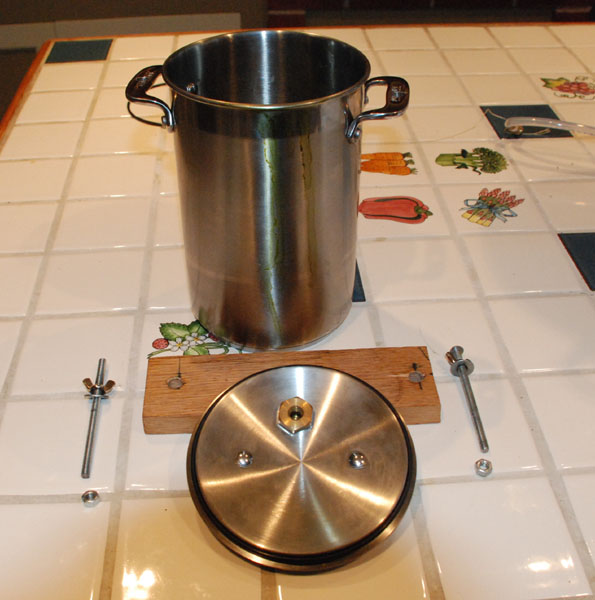
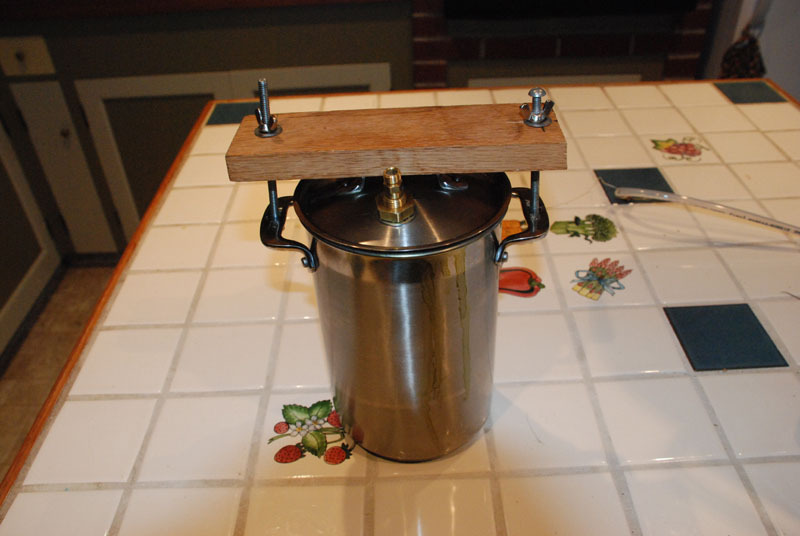
We modified the All Clad asparagus steamer pot by drilling a hole in each pot handle, through which I slip two 4" X 1/4=20 round head bolts, that pass though an 3/4" X 2" x 8" Oak board holding down the lid and be secured with washers and wing nuts.
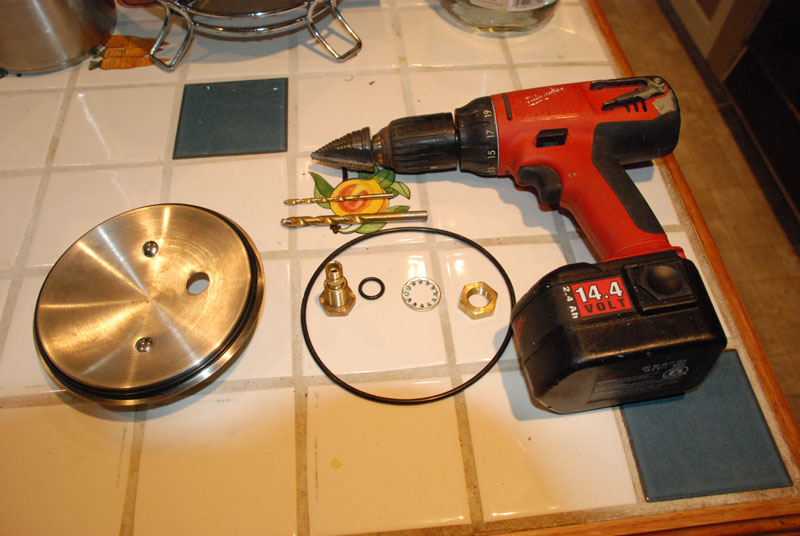
We modified the pot lid, by drilling a pilot hole using Canola oil as a cutting lubricant for the stainless, and using a step drill to open the hole to 5/8" to accept a 1/8" NPT brass bulkhead fitting. I roll a 5/8" X 1.125" over the fitting outer diameter, so that it seals with only hand tightening.
Attached is a parts list below for the above and the rest of the parts, but the use of a neoprene or Viton fuel hose for the application. Many plastics and rubber hoses leach badly in the alcohols passing through.
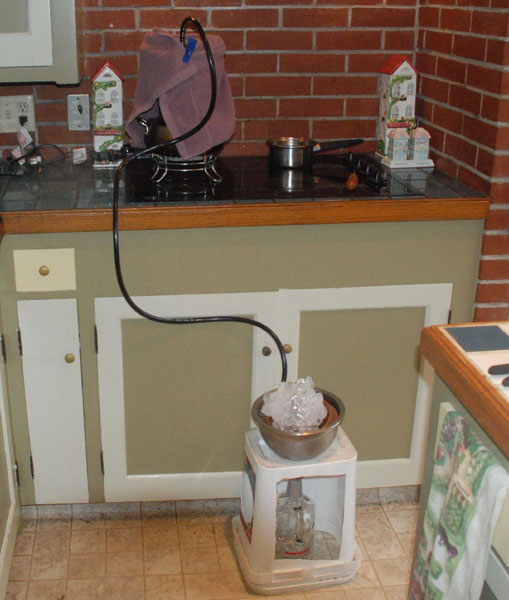
Operation of the still is simple. The alcohol is sealed up inside the pot, which is set into the pot of oil, which has its controls set wide open, or about 375ºF. I wrap a towel around the pot and 1.5 kw fondue cooker, to conserve heat and speed up the process.
A 1/4" fuel hose conveys the alcohol vapors boiled off, to the condenser, which is sitting atop an inverted cat litter bucket, with reliefs cut out. The bowl is filled with ice water, and after the alcohol fumes pass through its coils and reach the 1.75 liter bottle below, it is ice cold. Recovery is greater than 99% during this step of recovery.
We keep track of how much has been boiled off by how much accumulates in the bottle of approximately the same diameter as the asparagus, and mark on it where I wish to stop distilling.
We usually stop before all the alcohol is gone, and pour it into a smaller container to boil the last bit off to atmosphere where I can watch.
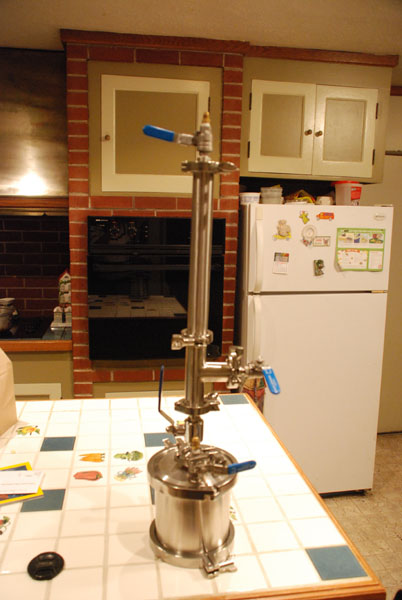
Here is the parts list, and some pictures:
1 All Clad stainless asparagus steamer 1 10" Stainless steel mixing bowl 2 1/8" NPT brass bulkhead fitting 1 Neoprene O rings for lid 5.375" X .125" 2 Neoprene O ring for bulkhead fittings 5/8” X .125 1 1/8” MNPT elbow to 3/16” compression 1 1/8" MNPT to 3/16" compression 1 5 gallon plastic bucket 2 1/4" 20 X 4" Plated carriage bolts 2 1/4" Plated washer 2 1/4" Stainless or chrome wingnut 1 3/4" X 8 1/2" X 2" Oak block 4' 3/16" ID Neoprene fuel hose 2 3/8" Hose screw clamps 12.5' 3/16" ID copper refrigeration tubing
Attached thumbnail(s)

I think your device is not very friendly. For the recovery of alcohol, there is actually a kind of equipment that is specially used to recover alcohol, and the recovery rate reaches 95%.(https://www.zzkdinstrument.com/products/Other/paint-solvent-recycling-machine.html)
test
Can i use a water distiller to reclaim my solvent and if so, does the process start decarbing the cannabinoids?If so, should i reduce the finishing time to compensate for the distilling heat time?
Joe used a Megahome water still to reclaim alcohol until it finally broke. Heat will decarb the concentrate, but the heat won't rise above boiling point of the azeotrope, so if you finish it outside the still, after removing most of the ethanol, you can avoid the more severe decarboxylation at the end, when the temperature rises. GW
Good information and ideas, thank you. I have been working on tinctures and concentrates as a licensed medical marijuana grower (with MS) here in Maine for about 4 years now using most methods IE cold,hot and a magic butter machine and those are good but I want to create a true concentrate using a 0.5L . Copper Alembic still to remove all the alcohol from the tincture I already make. Do you have any suggestions or ideas on using a still? Thank you Zachery Patrick
It's hard to remove all the alcohol with just heat, without degrading the material. I suggest heat and vacuum in a thin film for best removal. Gw
Hey GW, Am thinking of this Alcohol Distillation Set (http://www.borosil.com/images/home_sub_images/3452%20Distilling%20Appartus.jpg). I will be using this strictly to reclaim ethanol alcohol from QWET for RSO. Thinking of getting this asap. Any suggestions and thoughts would be very helpful. Also, would the reclaimed alcohol be ready to use immediately or would it require some other form of processing. Thanks and a shout out to all at SkunkPharm.
That is a straightforward boiling flask, distillation elbow, and graham condenser, which will work. The reclaimed alcohol will contain some monoterpenes, but we've reused it for both extraction and winterization with no issues. GW
Thank you so much GW, me gonna get me those :) Cheers
Is the reclaimed alcohol ready to use in another wash or does it need to be processed/purified first? If processing is needed, what is that process?
The alcohol will be a gin, in that it will also contain some water and monoterpenes, but we typically use it interchangeably with fresh alcohol. You can further purify it if you desire, using a compound refluxing still. GW
Just made a still similar to this one. But are brass fittings good to use ? Wont it leach into the alcohol?
Good point! They should be lead free brass. GW
Alternately, you can "pickle" the brass to strip the surface layer of lead (and oxidation). Mix 1 part hydrogen peroxide and 2 parts white vinegar. About 5 minutes in this bath will do, more is not better. Should be pale yellow when done. Another option is to cover them in solder (post install). If only lead free solder is touching the alcohol, the underlying lead in the brass cannot. This will also probably solve any leak issues. You could also skip the fitting and just direct solder (assuming you have the skills to solder the fitting) but I personally like having a disconnect.
jsut buy a glass lab still off ebay or amazon. make sure they are legal in your state.
Is there any reason that I need to use the neoprene fuel line? Can I just run copper for the entire length?
My all-clad lid leaks where the handle is riveted on so I was unable to reclaim any alcohol. Still weighing options on how I intent to fix.
Sorry to hear that! I built eight of them without that problem. Loose rivets can often be tightened by riveting them tighter with anvil, hammer and punch.
Flour putty. Mix some flour and some water till at clay consistency. Press in/over the rivet while in operationeel. The heat will dry it, it will seal like a charm.
Hello, Where did you purchase the ethanol? And are you able to purchase it in bulk? What about excise tax?
Try www.kleenxtract.com
Just wanted to make a few comments about this project. I put together this unit and found that there were a couple of issues; I could not find a 1/8" bulkhead fitting so I used 1/4 fittings instead. Got them from Amazon. I had bought an asparagus steamer and it of course had a glass lid just like every other flipping pot sold these days so I had a problem finding a metal lid to fit the 2 Qt. steamer pot. After trying a couple of thrift store metal lids, (had a problem with them rolling when clamped down) I finally found at Belks a 1 Qt Quisinart (sp) pan that ACTUALLY HAD A METAL LID. It is the same lid as the one in this post by Greywolf. The next prob I had was finding an o-ring that would work with that 5-1/2" lid and I ended up just having the local gasket company water jet me some gaskets out of VIton. The guy didn't tel me before he cut the gaskets that it was a $90 job and settled with charging me $50 under the table for 5 gaskets. I would be willing to sell 3 of them for cost ($10 apiece) if anyone is interested. They work really good with that lid. Seal up perfectly with no roll. It was nice to be able to recover about 3/4 of the ethanol from the cook that I did last night. Saved about $30 the first cook and should pay for itself in 5-6 cooks! Mark
ps - be careful drilling stainless steel. It does not shear easily and the drill bit hangs in it really bad when cutting through. Use lubricant.
pps - To Greywolf: great tip on using the Cuisinart Fondue pot for heat source. Works way better than a hot plate and boils the hell out of the alcohol thus reducing processing time greatly.
What size are the Viton gaskets that you have for sale?
Best I can tell without my glasses on is 5-13/32" ID and about 6-1/16" OD by a .125 thickness. Nice gasket...didn't leak even a puff of alcohol vapor last night when I ran it and it can be run safely inside with no blasting fan. Great system for recovering alcohol. Works like a "well-oiled machine"!
1) Why can't you use a hot water bath, instead of a hot oil bath, to immerse the pot full of ethanol you are trying to boil off? 2) Do you have to have the copper coil? Or could you you a shorter teflon hose, with the appropriate fitting, that attaches to an ethanol collection container sitting in an ice bath, for the recovery?
I hate to be one of those mindless posters struggling with the obvious, but... where do you get those brass bulkhead fittings? Definitely not a common stock item at most hardware suppliers.
I have been using a glass distillation apparatus off ebay for a couple of years now. It was something around $65 for a vacuum version, you can use it either way. One use for it is when you clean your oil rigs you can reuse the alcohol many times, usually losing about 20 ml per 500ml distillation. Then you can reuse the resulting oil for lotions, or I guess you could eat it, or well if you were desperate smoke it.
link please?
I know this is an old post but thought I should ad this information for any search engine users who find this. A note for the the distillation of alcohol. Look up azeotropic distillation to see the processes used to remove water from alcohol.
Sorry to necropost, but I recently came across this. One thing that concerns me. The alcohol will pick up water from the bud. Will the resulting distilled/reclaimed alcohol still be 95% pure? Otherwise, wouldn't it limit how many times you can use/reclaim it?
The more I think on this, the more I am concerned. By decarbing as you evaporate, you're temperature rises above the boiling point for water. Unless you are assured that the bud contains no water, this would certainly add water to the reclaimed alcohol.
Would it not be possible to then run the reclaimed alcohol through the system solo in order to distill the water? Also, for people less mechanically inclined, would chemistry lab essential oils extraction device work similarly? For example, the following device: http://www.ebay.com/itm/Essential-Oil-Steam-Distillation-Apparatus-Lab-Distillation-Kit-W-Simple-Stands-/231265070312?ssPageName=ADME:L:OC:US:3160
Yes, I believe you could distill the water out in a second step, as long as the temps are below the boiling point of water. I ended up picking up this unit, which was very highly reviewed and a piece of cake to operate: http://www.nutriteam.com/water-distillers/essential-oil-alcohol-stills/megahome-still-for-alcohol-essential-oil-making-glass-collection.html
Thanks for the input. I saw that one too and wondered if ti would do the trick, but it looks totally legit. I actually purchased the one I posted a link to and I plan to use everclear as a solvent to extract with, then purge and degas. I'll post my results.
How is this working for you? Any advise?
Did you ever test this and if so how did it work
If one was using this to reclaim alcohol out of absolute extractions, and was trying to keep the left behind product as light and clear as possible, would having the oil set to 375 cause the extract inside to decarboxylate, and darken? Would it be possible to set the oil to around the exact temp of alcohol boiling, and try to distill off just the alcohol, leaving the extract unchanged? Even if it sacrificed time? Also, would, for smaller scale production, a glass distiller along with said oil pot, and a water pump on the coil be better suited than this device? (by small i mean 30g or so per run.)
[…] sounds possible, i love the idea to have a desicator cabinet! for now http://skunkpharmresearch.com/alcohol-reclaim-still/ is a helpful start to reclaiming alcohol Reply With […]
Something else I forgot. When I recovered the alcohol it was still an amber colour, which I wasn't expecting. I thought about it and I figure it's obviously something else that has vaporized and probably better it's in the alcohol and not the oil. I see chlorophyll doesn't has a boiling point as such, but does have a melting point of 112 C. However I stopped reclaiming at around 90% in order to finish in a manner so I could inspect, so it should never have got to 112C, as ISO has a boiling point of 82C. Also, the reclaimed alcohol was amber consistently from the first drop to the last. Just curious more than anything.
I've never gotten any color, but I do get monoterpenes in the alcohol, so that the reclaim is a "gin". What kind of alcohol? How full was the still? What did you use for a heat source?
I just made one of these and processed about 2 liters of ISO. However when it re condensed it was still an amber color. Not so dark as before, but it still has a light yellow color. I did have some oil to show for my trouble, but I expected the ISO to be reclaimed clear, as I though the oil would have a much higher boiling point than the ISO? Any thoughts?
Clearly you are carrying over something. We use ethanol and it is always clear,though it is a gin, containing monoterpenes. I would suggest doing a second distillation and see what drops out the second time.
when you get a copper tube its best to run your setup with vinegar first to take out impurity's from the metals then water to rinse the lines and chambers it will smell a lot so best to do out side when cleaning this way. I've made stills before and recovery systems for alcohol . this setup is a good one to use just be sure to clean it before running it .
Would a Megahome Water Distiller be safe to use to evaporate and reclaim the food grade alcohol? Would it run too hot? The plan would be to remove it after most of the alcohol was evaporated and finish it on a coffee warmer to finish.
As long as you removed the last 10% or so while it is still a loose liquid, and finished it outside, it shouldn't be an issue, because it isn't under enough pressure to substantially change the boiling point. They do make counter top distillers just like that in Australia, specifically for ethanol production, and market them in the US. If you don't already have the Megahome, it might give you some selection and if you decided to try your hand at making alcohol from a sugar wash, it would be a lot handier.
It has been suggested by some that there are concerns with it running to hot and ruining the Cannabinoids and we certainly don't want to do that. This is in Canada, where 94% food grade alcohol is costing $75/1.14L.
The distillers made specifically for alcohol, have a lower thermal setting than those made for water, but until you get down to the point that most of the alcohol is gone, the temperature will never raise much above the temperature of the boiling point of the alcohol. The pot is too deep to do finishing in, because the difficulty of getting it out afterwards, so you could remove most the alcohol in the still and remove the balance in a hot oil bath, where you can be more precise.
before dumping into the still put the liquid into the collection container and mark it with a piece of scotch, the top of the tape at the liquid level. if you stop the still when the alcohol gets to the bottom of the tape you'll have about a cup left to finish in the oil bath. the last 1/4" goes pretty fast.
Would a megahome be safe to use with hexane?? I asl because I have a mega home and hexane but I am weary of the silicone o ring and it reacting? Is it even silicon it's a number because I really want to use it ... What do you think? Any help is appreciated we need some medicine soon.... Thank you in advance...
Hi GW Hope you are well Earlier in the conversation I enquired about materials. Have now built still. It's a portable electric stove with a SS asparagus steamer on top with sealed lid. 22mm copper pipe coming out the top about a foot vertically, then sloping down about 3 foot reducing in diameter to a 10mm copper coil in a bucket that has the garden hose running in it. Had a bottle of 37% gin in the cupboard so put that through it after a few cleaning runs with water and vinegar. I've bought an alcohol hydrometer. The gin now reads 50% after a second run through. Can't seem to get it any higher. What do you think? From over the pond.
To fractionate any closer, requires close temperature and multiple cycles using a simple pot still. If you turned it into a compound refluxing still, by adding a reflux column to it, it would be easier to reach 190 proof. Check this link: http://skunkpharmresearch.com/enabler-alcohol-fractionating-still/
Hi GW Although familiar with stainless steel fabrication, funds are a bit low at the moment. I presume it's ok to use copper. http://homedistiller.org/intro/types/fraction Thanks in advance
Copper will work, just no lead solder and keep the copper clean of oxides.
SPR please help me if you can. I have 80 gallons of Isoproyl that I have used for extraction, I usually use (10) 5 gallon cooking pots and hot plates to evaporate the iso, my issue is "I would like to find a safer way to do this process", do you know of a better way with such a large amount? Would a vacuum oven be a possibility? Any suggestions would be greatly appreciated.
I suggest that you investigate Rotovaps with cold traps, for evaporating off and reclaiming large amounts of alcohol. A vacuum oven would take a long time.
This seems to be a duplicate. Check out the compound refluxing still at http://skunkpharmresearch.com/enabler-alcohol-fractionating-still/
Great write up! If one were to use a pressure cooker for this, any thoughts on how you might heat it? I assume you wouldn't be able to apply heat directly as you would have limited control of the temperature.
The temperature inside the still won't rise above the boiling point of its contents at that pressure, but there are concerns about uneven heating, with wide control bands. One easy way would be to set a pot of water, oil, or sand on a hot plate, and set the still in it like a double boiler. You need to be above 173F to boil off the ethanol, but once it reaches much more than that, you are boiling away something besides alcohol.
I will DEFINITELY look into that! Keep on keepin' it real.
I'm currently learning to make medicine from a third generation master herbalist. I admit she has troubles with word retrieval sometimes(due to lupus flares) but is generally spot on when it comes to the information she does get out. I will definitely look into it further though. Love what you guys got goin on here!!!
Thanks for the good thoughts bro! A good book on essential oil extraction and history is The Essential Oils, Vol 1, by Guenther.
Greywols ever use silicone pads for this system if so how did u encorporate them?.
Nope, no silicone pads in the still.
For a reason??
Ethanol attacks silicone rubber. http://www.coleparmer.com/Chemical-Resistance
Feel free to correct me if I am wrong but shouldn't all medicine be made in glass ideally??? My understanding is that stainless steel can degrade some of the vital cannabinoids if it's used to cook in.
There is no reaction between the 300 series chromium base stainless steel and the cannabinoids that I am aware of. What is your source of information?
Can I cut my own seal from a neoprene sheet off amazon? is neoprene fuel hose really the best material to use for a hot alcohol vapor path and O-ring? or is it of no concern? i just dont wana anyone ingesting something weird when i reuse the Alcohol. I suppose i could just run more Copper Pipe and use a small amount of line to connect directly to the copper. Please let me know! ive done a bit of research but cant find a direct answer on Neoprene gaskets vs Hot ethanol vapors. Thanks! awesome tutorials.
Neoprene was specifically chosen because it is rated excellent for ethanol service. You could also use Viton. Here is a good site for checking polymers and metals for service in various liquids. http://www.coleparmer.com/Chemical-Resistance
Cheers!
All my stuff smells like Neoprene now specifically the Oil whats up with that? it tastes disgusting should i soak it in baking soda for awhile? ive had the sheet for over a few months now. been making product giving it to people then my homie came by with some oil i made for him and i dabbed it and it tasted like neoprene is the alcohol leaching something from it the neoprene or what
The oil shouldn't smell like neoprene. Are you sure the hose is neoprene? Here is a good reference for chemical compatability. http://www.coleparmer.com/Chemical-Resistance
not using a hose ive got an all copper and stainless path except for the seal
If it hasn't come in contact with neoprene, or similar material on your watch, my next thought is that you may have extracted something that tastes similar from the plant material. What was the plant feeding and flushing regiment?
Hi Gray Wolf I have an asparagus steamer, now I need the big seal Neoprene seals in the UK seem to be a bit rare. I can get nitrile or viton? Are any of the above acceptable? Or something else? On the subject of materials are brass fittings used in the plumbing trade acceptable to join steamer to copper pipe? Thanks in advance
Viton will work well. Yes, brass fittings are fine. I use a brass 1/8" NPT bulkhead fitting with an o-ring, and brass compression fittings to run the copper coil through it.
Hey I have another question :-) If I was to make this still.... could it be operated at lower temperatures.... (with the understanding that the recovery times would be significantly longer) My question is, what is the lowest temperature that you could use, and still reclaim your alcohol... it appears that it must be 173 in order for the alcohol to burn off, yet i was trying to keep my temps below 130.... is this possible?
You can cold boil alcohol at ambient temperatures under vacuum, but without vacuum, the temperature would be about 173F at sea level.
Is there a way to cold vacuum AND reclaim your everclear?
Yes, with an effective cold trap. It is tougher under vacuum, and we've yet to achieve the same percentage of reclaim as using our simple pot still, but we are continuing to work on it.
I am very interested in this in recovering ethanol with a lower temp and a vacuum. I need to learn about cold traps.
Hey Greywolf, I am building this still but cant find the 5.375 x .125 neoprene o rings. Hoping you would share your source for acquiring a few of them.
Most likely Seals Unlimited http://www.sealsunlimited.com/ or Gasket Specialties http://www.gasketspecialties.com/ here in Portland. GW
hi greywolf -- what is the capacity (volume of ethanol/oil solution) of your still as described? how difficult/expensive is it to add a vacuum pump to the still? what is the typical ratio of ethanol to dry material in your QWET extraction?
Hi Cedar! I will take some actual measurements and correct the following estimate, following my next visit to the lab. As I recall, the asparagus steamer is about a 6" X 10" pot, with a capacity to the brim of about 293 cubic inches, so functionally would process about 75% of that, or around .91 gallons. That still wouldn't gracefully accept a vacuum pump, but the Enabler will. It's column is ostensibly capable of refluxing up to 2Kw, so the pot size attached to the bottom is up to the builder, based on their local laws and circumstances. The pot in our prototype test sled holds about 182 cubic inches to the brim, or functionally about 136 cubic inches, or about 0.59 gallons. Here is the link! It has been on back burner, but is 90% complete and in the queue. http://skunkpharmresearch.com/enabler-alcohol-fractionating-still/ I like to fill my jars about 3/4 full of material loosely packed, and fill about 2" of ethanol above that. As it shares the same space as the plant material, less alcohol is required, but dry material will also soak up and hold a lot of alcohol. Depending on packing, the jar will hold maybe 80/90% of it's empty capacity, and lose around 10/20% when decanted and filtered, that is soaked into the material.
i'm confused, you say thc boils at 315, but your instructions say to heat it to 375? so we are supposed to scrape the hash oil from this asparagus steamer after the reclaim? seems like something with all those curves would be a pain to scrape...how do you do it? the instructions are thorough for making the still, but very vague about how to actually use it...
Even though the oil bath may be at 375F, the alcohol mixture inside the pot will not rise above its boiling point. Ethanol boils at 173F at atmospheric pressure and not much higher in the still, until most of the alcohol is gone, at which time the temperature elevates to the next lowest boiling point. Because we like to watch our oil during the final stages of purging, we don't remove all of the alcohol in the still. We distill it down about 90%, and decant the rest from the still for purging by other means. Usually by boiling off in a hot oil bath at 250F, or at low temperature under vacuum. In both cases, we judge completion by watching bubble formation.
and you're still able to get shatter when boiling off the EtOH at these temps?
im kinda wondering the answer to this also.
Won't the THC vaporize off at that high of temp?
No, THC boils at about 157C/315F, and ethanol boils at around 78C/173F. GW
good question, is the finished product now medibles only?
where is the page?
Its titled PNP extractions on the top of the page.
Use site search function for " PNP Extractions" Seek and ye shall find
how long does a liter of ethanol take to evap out of the oil?
~30/45 min.