


Oil and fat extraction is a method Skunk Pharm Research will be further developing, so watch this thread.
Cannabinoids and the other terpenes in cannabis, are readily dissolvable in fats and oils, so fats and oils may be used for both extraction and as a menstruum.
When I say fats and oils, I am referring to the vegetable and nut oils, as well as clarified butter. Oils tasty enough that may be ingested with a dropper, mixed with drinks, or used in medibles.
Water solubility varies, but one of the advantages of using oil for extractions, is that they are for the most part non soluble in water, so they don't extract excessive water soluble constitutes, like chlorophyll.
There are practical limits to the potency that can be achieved extracting with oil, because as the oil becomes saturated with cannabis terpenes, they become less concentrated and their solvent action slows down to a crawl, before stopping altogether.
Potency can be ratcheted up somewhat through using the same oil to do multiple extractions of fresh material, but even that has limitations.
A key factor in achieving maximum removal rates and efficiency, is keeping the boundary layer between the un-dissolved resins and the unsaturated oils used for extraction regularly removed. The method that we used in this experiment, was simple, but through periodic stirring.
Sublingual oil tinctures:
Aside from their useful role in extraction, oils and fats may be mixed at any ratios with cannabis terpenes, if you are just mixing them together as oils. Some of them are damn tasty even taken from a dropper, though as the concentration increases, the flavor becomes less fetching and it leaves more of a lingering aftertaste.
Choose an Oil:
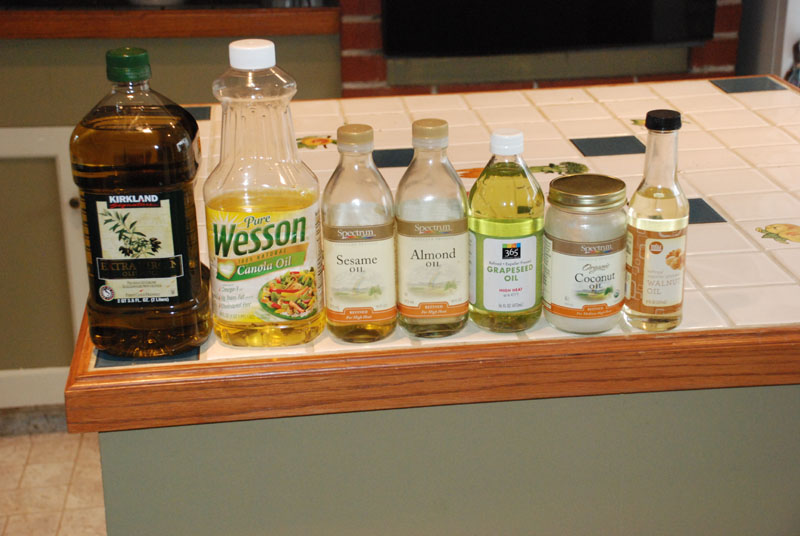
We haven't tried them all, but we have tried Almond, Avocado, Butter, Canola, Coconut oil, Grape Seed oil, Hemp seed oil, Olive, Pecan, Sesame, and Walnut oils. They all work well, so they are a good place to start, if you are new to extraction.
Here is a good link for determining the smoke points of the various oils:
http://en.wikipedia.org/wiki/Smoke_point
Preparing the material:
We first start by drying the trim. For the most floral flavor and the highest amount of lighter terpenes, material that is hung until it reaches the small stem snap stage is best for our purposes.
In our experience, for best flavor and taste, freshest material works best. Older cured material loses the nuances of the floral undertones and just tastes like hash.
That means that the degree of drying and curing is also critical, if your goal is to maintain maximum terpene content. Not that hash has a bad flavor, but it should be a conscious choice.
Choosing material:
Oil from buds is tastier than oil from even sugar trim, because most of the terpenes are produced by the buds, and that is where they are the most plentiful. Tasty is usually not a word used to describe oil from fan leaves or stems, though effective may be.
The material that we used in this experiment, was donated sweet trim from Chocolate and was well dried and cured.
Oils used in this experiment:
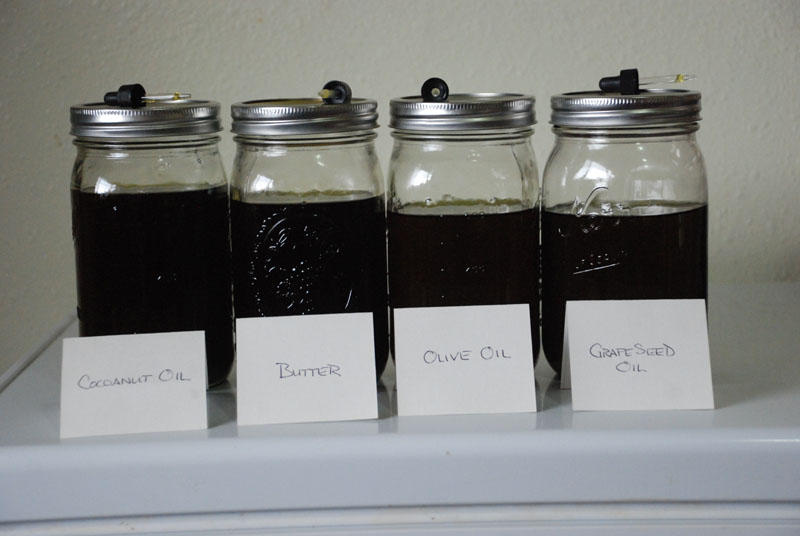
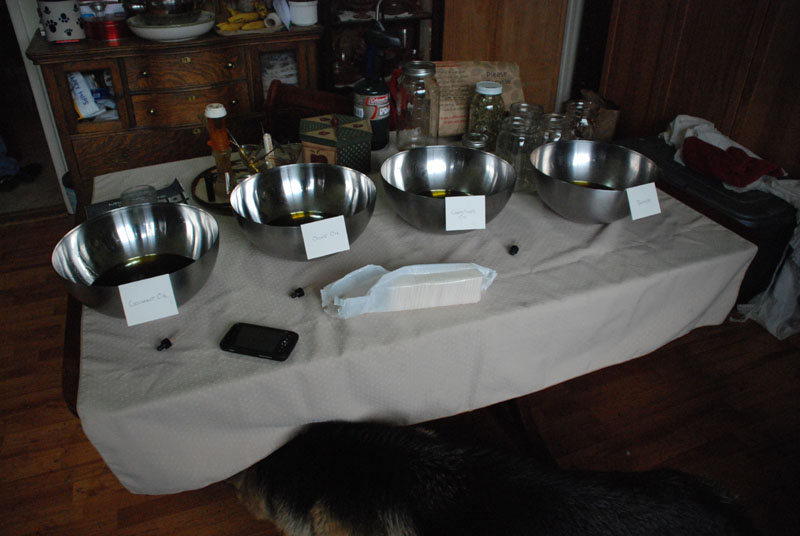
We used Ghee (clarified butter), Coconut oil, Grape Seed oil, and Olive oil for the run, because they are commonly available and inexpensive.
Making Ghee:
To make the Ghee, we melted unsalted butter and cooked it at low temperature, until the butter fats separated from the Ghee. We then skimmed off the floating butter fats, and sucked off the Ghee, using a turkey baster, leaving the heavier butter fats in the bottom of the pot.
Most recipes for extraction with butter call for boiling the material in water and butter, but we studiously avoid adding water and our Ghee extraction has only the lightest tinge of green and no chlorophyll flavor.
Here are the three extractions taken out of the refrigerator, where they were stored between cooking and actual pressing. Note that the butter, olive oil, and the coconut extractions have the slightest green tinge, yet none actually had a chlorophyll flavor.

In this experiment, we didn't attempt to reach maximum saturation, but to determine what was reasonable to expect from a single batch. To reach maximum saturation, we would have simply processed more than one batch of fresh material through the oil.
What we did, was fill four jars 3/4 full of the trim and then added enough oil to cover it, stirred it thoroughly, and then added another inch of oil. 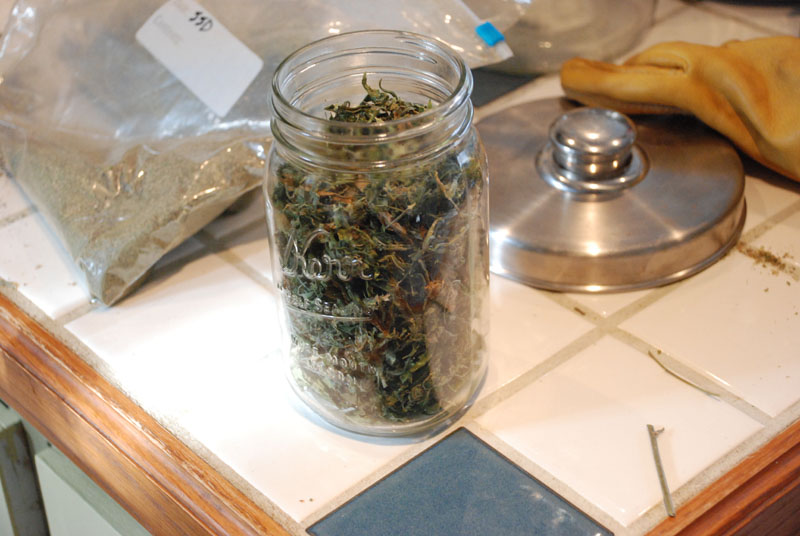
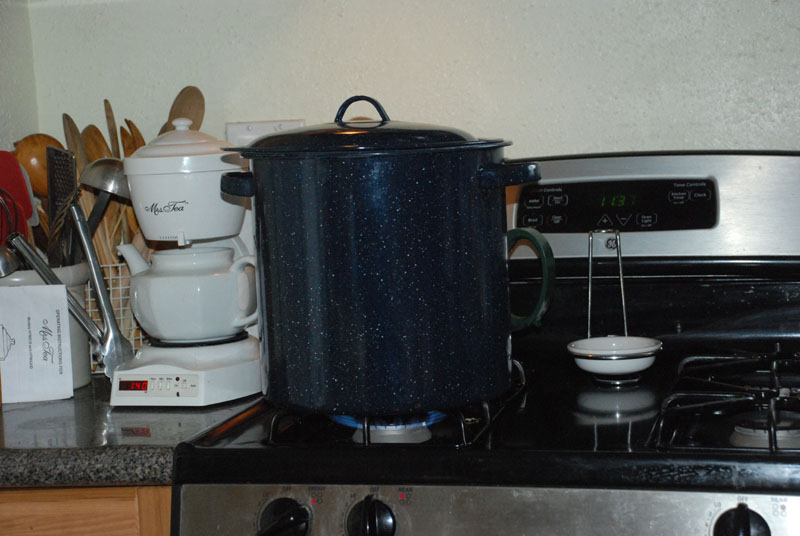
We then lightly capped the jars and set them in a pot of hot water and simmered it on low for six hours, uncapping and stirring thoroughly a couple of times an hour.
At the end of six hours, we removed the jars from the hot water and set them aside to cool. The next day, we cooked them two more hours, stirring regularly, and the third day we cooked them another six hours, for 14 hours total, with three heat cycles.
Lightly capping means snug enough to allow some pressure to build, but loose enough to vent off anything excessive. Since we used cured material and didn't add water, there were little in the way of volatiles to boil off and produce pressure.
I left the lid off the boiling pot, so as to not force steam into the jar head space. 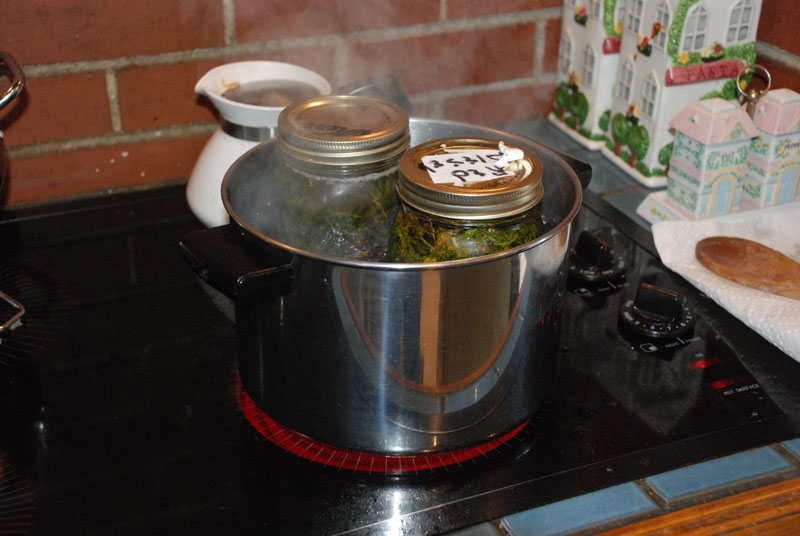
For pressing, we warmed the oils and ghee up by placing them in boiling water, this time with the lids on tight and the lid on the pot.
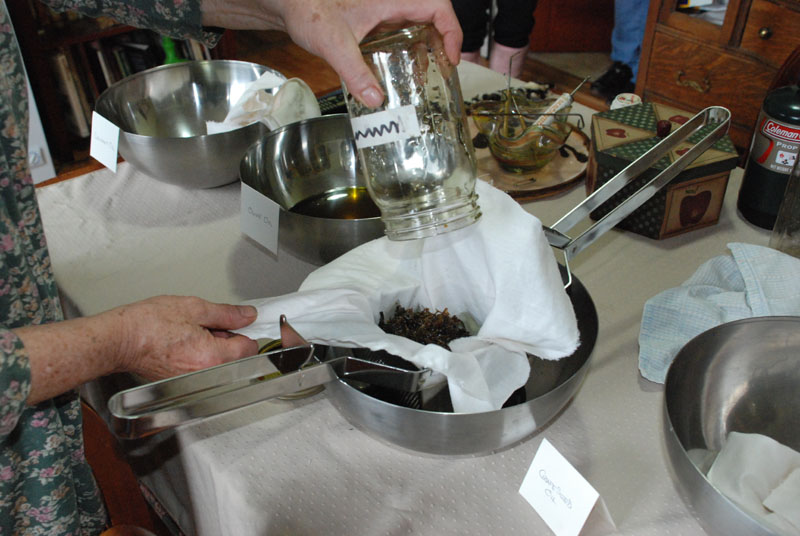
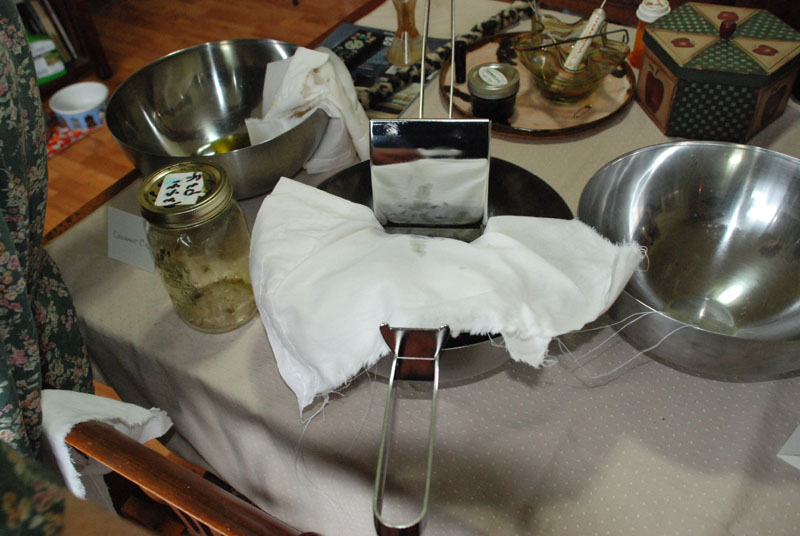
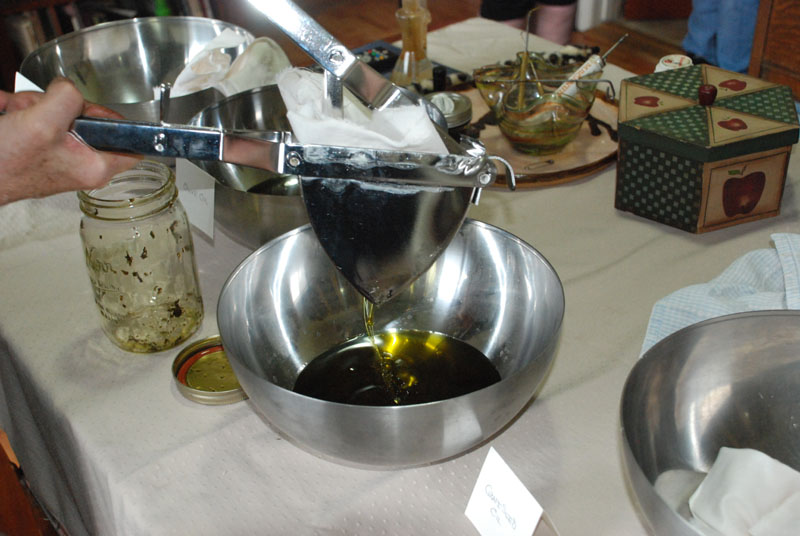
Next we cut up some rags from some surplus drape material, with approximately a 160/200 thread count, and draped it over a restaurant sized potato ricer that we scored at Hongs Restaurant Supply in Portland. By pressing it down into the potato ricer, it formed a pocket that holds approximately a quart of plant material.
Folding the cloth over and pressing it, produced a pristine clear oil, which was tasty enough to dropper.

The most flavorful, was the ghee, and possibly the fastest to uptake and produce an effect. Alas, after just testing just enough of each of them to determine their flavors, I needed a nap, so the next phase of this project, is to titrate for potency and effect, as well as flavor, using volunteer test panels.
We also will experiment with different ways to use the oils in medibles, so stay tuned!

I'm having a problem w/my latest batch of cannabutter and am NOT having any success in figuring out why or what to do in my researching online!!! So hopefully there's some help here... I'll first say that I have searched high and low in attempts to get an understanding of the SATURATION point of butter with THC...rather unsuccessfully!! Mostly, I have come to find that the consensus is that A) very little is known on this b/c testing and experiments to derive that data has not been able to happen (until more recently, although it still doesn't seem to have happened from what I have been able to find), and B) that the saturation point is more than you would ever really want or be able to achieve. I came across a general rule of thumb that said 1:1 raito in weight...BUT that it also needs to be enough to cover the material. So...I used 90G material in approx. 112G of butter (but NOT clarified). Problem...it was all of course VERY quickly absorbed into the material and some of the material not even submerged!! Deciding I wanted to use the water method again this time, I decided that the water would help w/the saturation and maybe it would be OK... I also made the mistake of altering more than one factor to my usual tried and true method at the same time (first was of course the quantity of material to the butter...normally I would use only about 18 or so G to the same amount of butter max). I also decided to try a less strain method I came across so I added MORE water when it was done so that the material would stay at the bottom w/ the water when the butter separated out and floated to the top. UGGGGHHHHHHH!!!! What have I done?!?!?! BECAUSE....of what should have been approximately 6 TBSP of butter in the end (b/c not clarified) I have ONLY yielded about maybe ONE TABLESPOON of butter that has separated from the water!!!! WHERE DID ALL MY BUTTER GO???? Is it possible that it is absorbed into the material and not coming out? Is it possibly too watered down and therefore cannot separate back out???? Can this even happen? I thought fat was NOT water soluble...??? Is it possible that there is THC extracted and suspended still in the water so if I put MORE fat into the water it will bond w/this THC??? PLEASE SPARE ME THE- YOU'RE CRAZY WTF WERE YOU THINKING comments! I already know this!! But if anyone is full of info and the data I am lacking and a SOLUTION so that this is not a complete and utter loss, it will be much appreciated!! I STILL want to know how much material to how much butter (or oil, or is this threshold different) is the saturation point and MOST that can be infused...is there any data???? AND I of course am DESPERATE for a SAVE to my situation. (In case the "you're crazy" kinds are interested...I'm going for a couple of things...ONE, I want my butter volume to be as little as possible due to the size of edible I am making...so I want the most potency possible in a smallest amount of butter. And TWO...I'm using mostly trim so the amount of material required for the proper dose is increased by at least 1 1/2 ish from what I have found in previous batches...which means more material weight being used in what I want to be less butter. CONUNDRUM. I'm obviously open to any knowledge and suggestion as I've filled my brain w/ as much researching as I can stand for the day!) Thanks for playing in advance if you do!! Fingers crossed there is a save out there...
Hello GW, I have been refining my method for extracting with oils. I use coconut oil and will find the best one available, higher saturated fat contents, etc. I will generally use around 2oz of material per every 16fl.oz. of coconut oil, cooked on low in a crockpot for anywhere from 6-48 hours. The matter is then strained with cheesecloth and refrigerated. I typically end with a mostly golden color. I've experimented with the timing and duration and have also tried a double boil like you've outlined. I'm curious about what you would suggest for temperature, duration, and ratios in terms of saturation? I have also experimented with MCT oil powder, adding a little of the medium chain triglycerides to try and boost saturated fat content and thus add more cannabanoid absorption sites. I've read about the potential benefits of adding soy lecithin to the oil as well, and have since experimented with this too. The idea is the lecithin granules help establish the unsaturated fat layer, which of course is broken periodically to, effectively, restart the absorption process. It's also purportedly used to prepare the stomach and GI to accept cannabanoids and allow for a more rapid blood/brain barrier transfer. I would like to know what you think of these methods? -Jared
Does any decarboxylation occur during the boiling of the jarred materials?
Yes it does. GW
Yes! Anything above around 125F causes some decarboxylation. GW
Hi I am trying to make CBD oil for medicinal and pain purposes only. I do not wish to have any psychoactive effects from the oil. Will the method of extraction listed here give me those results or will it in fact produce psychoactive effects? If so, is there an oil extraction method I can use that will not produce any psychoactive effects?
The methods listed here MAY get you high. To assure psychoactive effect is why people speak of keeping the heat elevated or baking the flower before extraction. If you want as little psychoactive properties as possible use as little heat as possible. I would suggest taking flower buds of known weight and thc (thc-a) percentage, put that in your cuisinart with half as much coconut oil or mct oil and for every cup of oil 1tsp of lecithin. Blend till you have a smooth puree. You can take this by spoon. Some flower decarboxylates a lot with curing and storage, most doesn't, so take a teaspoon some evening when you are planning to stay home. This SHOULD NOT get you high but should relax your body and ease your pain. You can do the math, (flower weight in mg) X (flower thc percentage (,20 for 20%) = total mg of thc-a, you can easily take 100mg this way though to be safe I would start with 20mg and work up after knowing it does not get you high. {The flower you buy at a dispensary list percentage thc, but really it is a computed number from the actual percentage of thc-a}
I want to make salve for my knees and back. How do I do that? And when you cook in crock pot do you add water too? Or just oil and flower
The process will extract what is there. If you want high CBD and low THC, use a strain bred with those values. You can also take 3X the THC dose in Citicolene 30 minutes before the oil dose, to help mitigate any psychoactive effects. GW
The best way to reduce psychoactive effects, is to start with a high CBD, low THC strain. Psychoactive effects occur when THC makes it to the CB-1 receptors in the brain, and to reach them it must pass through the brain blood barrier, which it can't until its size is reduced by losing its COOH carboxyl link through decarboxylation. Relying on the THC still being in the carboxylic acid state as THC-a, and therefore too large to pass the blood brain barrier is risky, because it will decarboxylate naturally over time, making shelf life critical, and of course storage is critical to insure that it doesn't get inadvertently overheated. Dr Melamede recommends giving 3X the oil dosage in Citicolene, about thirty minutes before the oil dose, to mitigate psychoactive effects, so you might give that a try as well. GW
Hi Skunkpharm, I have been making butter for a few years now using a ratio 1oz of fresh, top shelf bud per 1lb of unsalted fresh churned butter. I also add between one cup - two cups filtered water into the mixture of finely busted herbs and melted butter, I find this helps with washing out any undesirable flavors from the end product. As the butter and water separate in the refrigerator overnight the impurities (plant food, etc) sink to the bottom and are drained with the water I use a double boiler method consisting of two pots on a gentle simmer for 4hours. I am interested in your jar method and am curious as to whether or not you have tried adding water inside the jar? Is pressure an issue, will this cause seepage, or worse a burst jar? Also, have you ever gone over 1oz per lb, say to 2oz? And can I go longer than 4h? You seem to have but at what point will the THC break down to CBN? Thank you for your wonderful site!!!
Morning Steve! We use clarified butter and don't add water, because water is extremely polar, with a dielectric index of about 80, compared to even ethanol with a dielectric index closer to 24. Anything above 15 is considered polar, and clarified butter would non polar. Water also washes away the water soluble chlorophyll binding proteins (WSCBP), allowing the chlorophyll to be picked up and transported as micelles. If you don't submerge the jar tops and leave the lids slightly loose, there won't be any pressure issues. CBN is also broken down, so you have a general decline in cannabinoids. I've seen processes that cook the material for about 14 hours straight, and the jars are periodically shaken, but not stirred. The key to fast dissolution is keeping the boundary layers refreshed. The good news is that all you have to do to tell where you are at in the process, is to inspect the material at 100X to see if any heads remain, so if you wanted to run it in one shot, that is how to tell where you are at and when to stop. It won't ruin it, and most processes do it in one shot, some without stirring. GW
You can thin it with vegetable glycerine or propylene glycol. What you have is Rick Simpson Oil.
A first try, used everclear. I burnt it, almost but not crispy. Still moist. No liquid honey. WTH do I have? Wasn't able to suck up in a syringe. Can it be used in anything edible? Thanks
Here is how I suggest extracting with Everclear: https://skunkpharmresearch.com/qwet-extraction/ GW
If there's something I've ever noticed it's when picking your oil to extract be sure you don't use a volatile one now you're stepping into the dangerous boundries you might as well just use alcohol or some other flammable material. what happens to the compounds as you extract with these oils? 15 years of research guys and theres one answer now. We supply labs so no worries on the high prices. Joe Kyser has done it guys. Been there done that 15 years ago. Thats all old techniques dating as far back as 40 years ago. The old heads will concur. I had a meeting with one from the valley last night. He just outlined to me how cutting edge i am and how these methods are now ancient. Leta go guys get with the program. Old and tested lets introduce the new way to extract nontoxicly with organic compounds
Joe, you are dancing a fine line with our spam rules. Instead of telling us the other oils are bad and yours are good, please share with us what is in your solvent,as well as the details behind why it is so good. GW
From canning jams, tomatoes, etc. for a long time I can say I've never seen a Ball Jar break. 45 years ago, we'd fill them, seal them, cover them in water and boil them for a while to vaccuum seal. No probs. Worry about other things, like having a towel in an oven.... ;-)
after i just posted my comment i saw yours haha just backs me up 100%
Lisa two things, fist to get the the-a or any acid form, just eat the bud/flower raw. make a pesto or whatever. That will go straight to the belly and be where it needs to be. the the-a is especially good for gut inflammation. for the bleed use bone broth and find a chinese herbalist. there are lots of herbs to help with that. charred ai ye helps a lot and yo can get it in china town. more specific questions darby at cgca dot us
This makes it sound like you believe I have a lot of access to fresh leaf/flower? I have but one plant (clone) going, just 12" tall, at the moment. Are you indeed referring to green plant material, or dried leaf & flower? And is any bunch of strains known for TCHa and CBDa? I got the impression just hemp has plenty...? Is that accurate?
I'm a really good cook, former math/sci geek, suffering with GI bleeding given to me by NSAIDs (it actually happens a lot). Been treated for 2 months with no change by BigPharma corticosteroids, now they want to put me on auto-immune drugs... to treat an Rx-induced bleed. "Not so fast," say I. If anyone is isolating CBDa, CBG CBC, please let me know and I'll gladly subsidize. If however, all I can do is cook it myself, I have a crock pot, a pressure cooker, a potato ricer and some wicked knife skills. My only relatable kitchen experience is in making flavored syrups (ginger is my fave, but I do mint and lavendar), jams and flavored vodkas. I'm getting some relief from a whole bottle of CBD oil (Trishula brand) taken a dropperful at a time over about 48 hrs (approx 15 mg CBD), every time I thought of it, but it's marked only CBD, not CBDa. So there could be even more benefit to other isolates, hm? All suggestions appreciated. If you're in LA I'll cook you dinner. TIA
without a doubt i have partners that have what your looking for
Great. Would love to connect on this. Can we ask skunk to connect us?
Try clicking on his address under his name. GW
I don't have plants, is there a way to make the butter using RSO ? Ty I'm new here and learning so much
Hi, I've already produced a few batches of oil using a couple of different methods, the one described in this article is preferable. I'll be using kief to produce my next few batches of oil. Is the same decarboxilation time/temperature required, if at all? Thanks for your ongoing open research and assistance!
This process seems so cumbersome. Isn't there a more direct route to achieve similar results?
All I want to know is what is the best temperature to cook any of these oils at and for how long. I've heard to cook between 200 and 250. I also read 9n this website that CBD CBN and THC all melt at just under 180 degrees so 180 is fine for 12 hours. What are your opinions? I hope to hear directly from Skunk Pharm Research but any input is appreciated.
Why take something so simple and try to make it complicated attaining much higher results with a lot less effort. if you would do more research it would benefit you greatly mr. Sarcastic know-it-all professional expert non- novice serious competition
I'm so happy to have found this site. Thank you sooo much for all the excellent info you are providing! I've been researching CBD as a medical aid a lot lately and your site if the best I've come across. I've just started on my first oil extraction, using your method, with coconut oil. Wish me luck! xx Tania xx
I'm reading all the fine ways to extract cannabis into oils, and I've not seen any information on using various strains for their different purposes. For instance, high-Sativa strains will be energizing and high-Indica strains will be relaxing and sleep-inducing. Also, Sativa strains, in overdose, produce anxiety and paranoia and insomnia, whereas overdosing on Indica strains just puts you to sleep. I do my extracts into olive oil or hemp oil -- olive oil for everyday use of your favorite strains (lower costs), and hemp oil for the high-CBD medicinal strains, in the assumption that the hemp oil contains some of the beneficial medicinal cannabinoids. I work as a trimmer, and have consistent availability of certain strains. I keep the sugar trim from each strain and dry it separately, then pack my crock pot (takes about 5 oz of dry trim, no shade leaves) and cover with oil (approx. 2-1/2 liters). Olive oil smokes at 185 degrees, and my crockpot stays at 175 on low setting (Use a meat or candy thermometer to check.). I let it cook for at least a day, then strain and bottle. My oils dose at 1/2 to 1-1/2 teaspoonsful, depending on one's tolerance, and effects last up to 12 hours for body healing. Psychoactive effects will manifest about an hour after ingestion and last another hour or more, can be minimized with smaller dosage and of course increased with a higher dose. I've found the following reaction to certain strains, and I note that everyone's reaction is unique to themselves... OGs: everyday use For me OG#5 is pain-relieving and mood-stabilizing. One teaspoonful in the morning gives me pain relief for 12 hours, a little head high mid-morning, and a calm attitude all day. Skywalker OG throws me off-balance and is a little too edgy for me, but it seems to work well for men, for some reason. XJ-13, a Jack Herer strain, works well for a busy work day, doesn't make your head fuzzy, and has a high CBD content. Silver Haze, lovely stuff that's been around for decades, is one of the best sleep-inducers, especially if your trim has been around a long time too and has naturally decarboxylated. Lamb's Bread, a pure Sativa from Jamaica, defies the usual Sativa profile and induces sleep readily in small doses, but if you overdose, it does the Sativa thing and gets you anxious. Cherry Pie, probably Sativa-dominant, is one I use for real head-tripping, as it stimulates creative thinking for me. I nickname it CP, for Clear Perception and also for Certainly makes you P a lot! Diuretic, anyone? Anyway, you get the idea, and I hope this information gives you some directions to go to find the cannabis strain that works best for you.
Did you need to decarboxolate the trim and bud before your all-day crockpot cook?
ChristmasCarla doesnt do any heating besides the crock extraction of 24hrs or so @ around 170F I happen to know though, that she sorta has a back-log of material to process and prefers to use a bit older sugar trim that has already started decarboxylating naturally with the passage of time. I can attest personally to the effectiveness of her oils and feel she doesn't "need to" decarboxylate more.
Do you have an idea of the time needed to complete a natural decarb? I'm curious if this might bring out the best in the medicine..
Thanks for that info. Much appreciated.
I have 2 mason jars that are filled (3/4 full) with some shake and some bud with ever clear (ethanol 95%). I decarboxilated the greens before pouring in the ever clear. I am wondering if I use a seperatory funnel to pour the ever clear into grape seed oil and then sperate the two layers, if (1)the THC will go into the oil? , (2) there will be an equilibrium with some THC in both the ever clear and some in the oil. I have kept the jars in the freezer for a week with daily removal and shaking and then putting it back in the freezer. My real concern is that the everclear "burns" just about any tissue it is put on. hint: do not try ever clear suppositories!
Did you ever find out if the thc moved from the alcohol to the oil? Very curious...
Where can i buy hemp, to make my own cbd oil?
following... I have the same question.
you can buy it on amazon or ebay pretty easily. Ive just purchased 50G's.
I believe Sensi Seeds in into hemp for commercial use.
I get my hemp from here. https://www.kanapinis.eu/product/selected-hemp-buds-rich-cbd-40g
Grocery Outlet has quart bottles for $8.99.
CBD-HEMP on Amazon are excellent sellers and very helpful. Their hemp is great quality and high CBD content. Hope that helps :) xx Tania xx
Glad to find this site. For medicinal reasons I want to make CBD paste or oil. Stoned chef, would you sell some of yours? Are folks using cannabis or hemp as their starting product? If using hemp, can one buy 1/2 pound somewhere legally? Thanks!
Hi Sally. I've just started making my first ever CBD oil, also for medicinal reasons, I have auto-immune rheumatoid arthritis. I'm using the oil extraction method, with coconut oil. It's simmering away on my cooker atm on it's first hour :) I found a great supplier on Amazon, they are called CBD-HEMP. I buy their cbd female hemp bud. The new batch they've just got in is way higher in CBD content than any others I've seen - 10.8 %. It's totally legal as it's not psychoactive and is usually sold as hemp tea. I bought 100grams for £38 :) Hope this helps xx Tania xx
Hey I'm trying to find the CBD-Hemp on amazon, but it's not showing up. could you post a link. also... i wonder what state or country are you in? might just be illegal where i am
HI there, I am making CBD oil right now. I did 20g of CBD bud to 1 1/4 cup coconut oil. What I would like to know is how much to take? Does anybody know? We were using high quality CBD oil from a great company and we were taking 25mg of that a day. We are trying our best to replicate that, but we know that their CBD oil was extracted by CO2.
I recently read that it's important to pasteurized To eliminate mold and/or bacteria when doing an oil extraction. Is that true? Thx
No. You're adding raw plant material which contains water (providing bacteria with life) to an oil, so there's already the potential for food-borne illness if you leave it out at room temperature. Make your extraction, cool it in an ice-bath (look up ServSafe two-stage cooling for the proper procedure) and then store it in the fridge, or even better in the freezer (which maintains the properties of the oil, prevents rancidity, and nearly eliminates risk of food-borne illness).
so what sort of temps are used here, and does it fully decarb during the process? or are we supposed to decarb before/after sorry i'm a bit confused.
You could decard first, but the extraction process itself will decarb the material sufficiently as well any baking that would happen when making edibles. Decarbing before all of that might be a little to much heating, actually.
No sir. That is absolutely wrong. You MUST decarb to activate the inactive THC and even turn some of it to the medicinal CBD. If one were to decarb at the right temp. for the right amount of time one could turn almost all of the THC to CBD/CBN! I get my canna-coconut oil tested regularly at SDPharmLabs and am telling you this from over 2 years of getting my oils tested.
THC doesn't convert to CBD during decarboxylation.
Nice article ! Thanks
Yes
Hi, I'm wondering if I can do the extraction then decarboxylate my oil. Thank you
Yes.
You MUST Decarboxylate BEFORE you make the oil. I do it at 240* for 40 minutes. I then put it in my NINJA and make the trim like a powder. I put it in my crockpot and add 1 shot of EVERCLEAR per 3oz trim + 14oz Jar Organic Vegan Coconut Oil. I let it sit in the CP for 3-4 hrs and strain with Cheesecloth agitating every 20-30 minutes. I graduated Le Cordon Bleu Dallas and worked for Wolfgang Puck Catering in Dallas,TX so I kinda know what I'm talking about! Peace & Good Luck! StonedChef
http://www.sdpharmlabs.com/tests/1974.pdf 18.6mg THC/.29mg CBD/.19mg CBN - PER MILLILITER (ml) with 15 ml being in a Tb and 2 Tb in 1fl oz that equals.......558mg THC/8.7mg CBD/5.7mg CBN PER OZ OF MY CANNA-COCONUT OIL
Hi My wife has Ms with lots of pain and other problems, we made a batch of oil using cbd critical mass and extracted with isopropyl alcohol (we followed the instructions for Rick Simpson oil) The problem is, the finished oil is now so pure and strong that even a tiny pin head drop sends my wife into crazy, whacky land, its way to trippy to use and lead a normal existence, Also we have some dried bud left that we were advised to heat and this too is just as strong, so of no use. We were wondering if anyone knows of a way to make it less potent! We assume the THC has been heated and activated very well, can we destroy this to leave CBD or will this also be destroyed in the process? Ta
Assuming you are making oil that is 60% thc, then even one drop has 30mg in it. If it has all been decarboxylated then it will pretty much all pass into the brain. Unless you are a long term heavy user this is way to much, beyond trippy for most. Your choices are dilution or distance or a combination. Dilution means for 1 part rso 2 parts oil of your choice of other oil. This will yield 10mg per drop, a far more pleasant experience. If you take this dose under the tongue every 4-6 hours you will develop tolerance. If this is still too strong dilute in half a small portion of it and follow the above dosing till she is tolerant. Distance means rectal suppository or topical foot application. There will be some dosage that gets her high but it should be quite a bit higher allowing much greater dosing. Both require some dilution in fat to promote absorbtion. In the future you want non-decarboxylated thc also known as thc-a. This will not get her high and will focus the treatment in her body where the inflamation is. If you have further questions darby at cgca dot us
In my experience you want the THC and cbd in order to treat any ailments Try reducing your oil in MCT oil It's a good way to treat h out your oil and make it last but will also reduce the high somewhat
http://www.garmaonhealth.com/add-raw-cannabis-to-your-smoothie/
Isn't isopropyl alcohol poisonous? If so could that be what is giving the unwanted effects?
Hi, do you know what the maximum saturation is for coconut oil? And how many times you can process new batches through the oil. I have been using the magic butter machine and have reprocessed only 2 times so far using 3 ounces of shake to 1 cup of coconut oil. And I am not sure if I am just wasting the cannabis, or if I could get even more out of it. Thanks for any help in advance.
If you take dried coconut, not from a bag it has additives. Grind coconut and material to a fine powder. Put this in your butane extraction device. This produces an edible that will stay in a liquid form. The process binds the oils together and makes a potent cocktail. Try it you will like it.
I use straight organic honey sometimes heritage stone brand glycerin food safe always ad honey I don't know if it's the enzymes in the honey or what it works well
I have my co2 extracted oil,and I have MCT OIL, CAN I MIX THEM WITH OUT HEAT FOR TINCTURE, OR HEAT TO MIX AND WHAT SHOULD THE RATIO BE FOR 1OZ.OF MCT OIL TO PURE CO2
Cannabinoids have a solubility of 500 mg/ml or greater in light mineral oil. I'd guess the solubility would be similar in nut oils.
Mike, do you have a source for this? It sounds right I am always trying to find capacity research as I change formulations though. Thanks.
Check out the Magical butter machine! its so easy, its seriously set it and forget it! THIS THING IS THE BEST, made 80 strong ass cookies off 1 oz trim Here's the link they sent me so my buds could get $25 off http://magicalbutter.refr.cc/JFGDNKB This thing has by far been my best purchase of the year
I now have two of those machines and love'em! I grind up my sweet leaf or bud with a coffee grinder - to a fine powder. Add in two cups of coconut oil, 1-2 sticks of butter, soy lecithin .. set it and forget it! Afterwards, I pour the entire contents into a big glass bowl and refridgerate. The cold seperates the 'sludge' that falls to the bottom and the top is a pale, creamy green cannabutter! I use it to make all kinds of baked edibles. Easy, no muss, no mess, no fuss! Turns out GREAT everytime! And, it self-cleans.
Have you come to any conclusion as to what might be the best oil to use, or is a combination best? Maybe it would be best to use several different oils independently because they each have different pros/cons? There is a lot of differing views on this, I'm just wondering if you have any insight on the subject... Thanks or all you do! Have a great one!
No, because they all worked well and all had their own taste profiles.
Hi skunkpharm, i was wondering if it would be possible to furthur speed up said extraction by sealing the oil and plant material into a mason jar, then placing all those jars into a pressure cooker and blasting it for 30-45 min. Or would the heat be to excessive and cause degredation? It seems like if the jar was fully sealed and heated then cooled before opening all the terpenes would remain inside.
That will degrade virtually all of the THC into CBD. Great if you want the result for pain medication; not so great if you want psychoactive activity.
Maybe you can help me out. I'm looking for something to help with pain....smoking helps, but I need something more with 'body high' effects. My stomach is paralyzed, so eating causes the pain...I got some suckers from Colorado, but they didn't seem to help much...so I'm trying to figure out the best way to make my own for what's need. I also need the 'munchie' effect lol....
If I were you I would do edibles. When I was diagnosed with Breast cancer I started flooding my body with edibles. When they did the surgery no sign of the cancer was present.
LOL I meant to say drinkables for you, not edibles of course. Unless you can eat chocolate without too much pain.
THC doesn't degrade to CBD, it degrades to CBN.
CBN is a good thing!. But I don't think THC degrades 'into' that.
THC does indeed oxidize into CBN. I must say while I have not verified that personally with an electron microscope or a hplc analysis it is what is listed in every reference I have found via google and print. :)
Just the answer I was looking for. Thank you. Perfect for what I need it for. Topical treatment. Nice.
You really aren't as interested in more heat, as keeping the boundary layers removed to keep the desolution going at maximum efficiency. As noted, excessive heat destroys some terpenes, and converts others to something else, like a diterpene THC to CBN.
If I'm extracting a small amount (3.5 grams) would it be necessary to cook for as long as you did? Maybe 2 hours maximum? '
I am using a Pressure Cooker XL. I put melted butter and cannabis in jars (1oz per lb of butter) and close to just less than finger tight. I put it on 10 minutes. It takes appx 15 minutes to get to pressure. I will post s soon as i have it tested. I am getting the best butter and/or c oil ever. It does retain floral notes and smells contrary to what people are saying.
I was wondering why no one was using a pressure cooker?! Seems obvious. Even, to process just the plant material + oil... it'd be better than leaving it all day in a crock pot or a stove... wouldn't it? Can one of the experienced ppl chime in here?
Skunk Pharm Research, do i Have to put the butter and bud in a mason jar or could i leave it in a Crock Pot and just put that back and forth in cold and heat until I Am done and then strain it into a jar.?! i do Not want to mess it up, it is for my Mom who was just diagnosed with MS and has never really taken cannabis besides cbd oil.
A crock pot could work OK, but it's hard to control the temperature as easily as you can with a water or oil bath. Perhaps if you could find a dimmer of some sort that could handle the wattage of the crockpot and combined that with a thermometer it would be enough.
A crock pot works fine!